Coffee market

Uzbekistan's coffee market is in an active stage of formation. The country has historically been a tea market, but over recent years coffee has been entering everyday consumption ever more visibly: the number of coffee shops is growing, coffee-to-go culture is spreading, and interest in whole-bean coffee and local roasting is appearing.
Published market estimates suggest total coffee demand in Uzbekistan could grow from 6,000 tonnes in 2023 to 7,740 tonnes by 2028. For a market where coffee has yet to become a basic daily habit for most of the population, that is an important signal: the category is moving beyond a narrow urban audience and gradually becoming part of broader consumer behaviour.
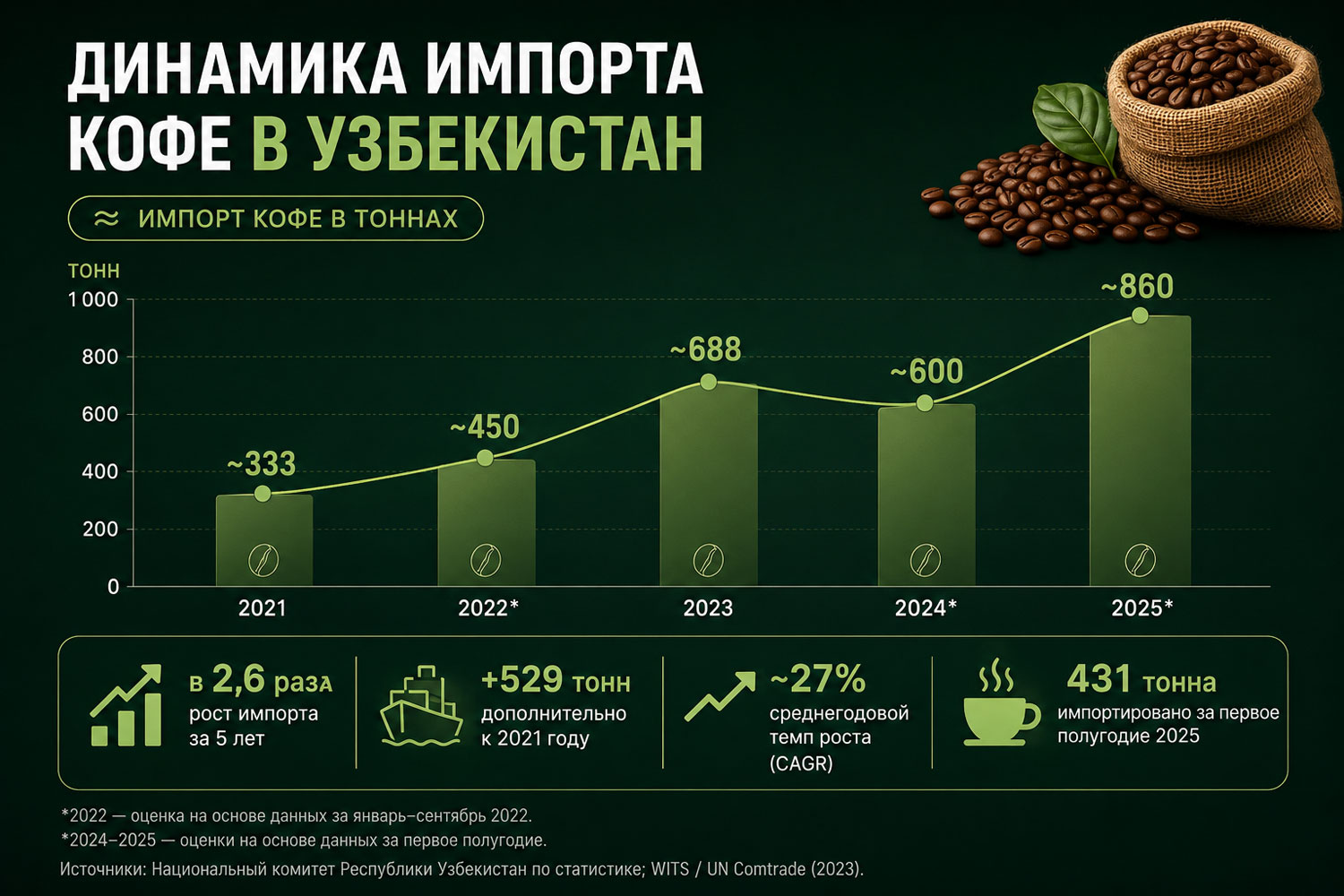
The market remains uneven, though. A significant share of consumption still goes to instant coffee, coffee mixes and affordable mass-market formats. At the same time, interest in fresh coffee, whole beans, coffee shops and professional consumption is growing. Published trade statistics confirm it: in January–June 2025 Uzbekistan imported 431 tonnes of coffee, 133 tonnes more than in the same period of 2024.
Against that backdrop the gap between the mass instant segment and new urban demand for quality coffee is especially visible. It is between those two poles that space is opening up for local roasting and affordable mid-market whole-bean coffee.
A market between two poles
Uzbekistan's coffee market today can broadly be split into two large segments.
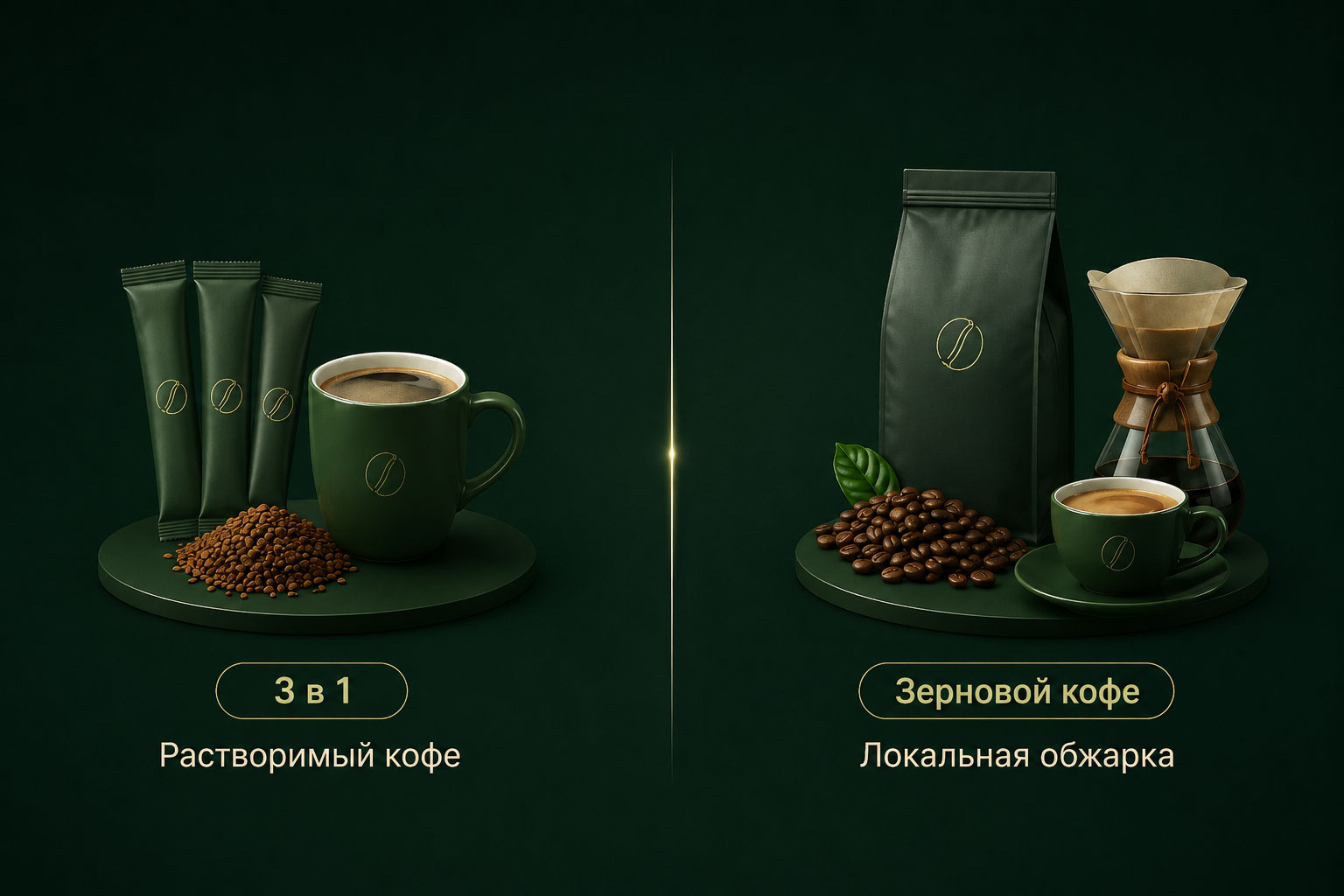
The first is the affordable mass segment: instant coffee, 3-in-1 drinks and inexpensive everyday formats. It remains the most familiar to a wide audience thanks to price, a habitual taste and availability in retail.
The second is the urban premium segment: specialty coffee shops, signature drinks, local roasters and venues with a higher average ticket. This is where the new coffee culture is being formed, though it is still concentrated mainly in the large cities, above all Tashkent.
Market reviews confirm that structure: Euromonitor notes that demand for fresh coffee in Uzbekistan is growing fast, but instant coffee is still the largest category by volume, with coffee mixes playing a significant role.
The main growth point is the mid-market
Between instant coffee and expensive coffee shops, room is appearing for the most promising direction of all — affordable mid-market whole-bean coffee.
This is coffee for vending machines, supermarkets, hypermarkets, DIY stores, business centres, filling stations and other locations with heavy daily traffic. For the consumer it is a "quick, convenient and affordable" format, but no longer an instant drink — it is coffee made from beans.
This segment does not call for rare microlots or expensive specialty coffees. It needs stable commercial origins: Brazil, Vietnam, balanced arabica and robusta blends. Those beans can deliver a clear flavour, good body in the cup and a price that stays closer to the mass market than to premium coffee shops.
This is the layer that can gradually change consumer habits. Someone used to 3-in-1 coffee gets the chance to try a better whole-bean product without a sharp jump in price. After that, going back to instant becomes harder — not because of fashion, but because expectations of flavour have changed.
Imports show growing interest in the category
Uzbekistan remains an import-dependent coffee market. According to the National Statistics Committee, in January–June 2025 the country imported 431 tonnes of coffee worth $3.9 million from 36 countries. That is 133 tonnes more than in the same period of 2024. The largest suppliers over the period were Italy, Brazil, Vietnam, Russia, Germany and Lithuania.
These figures matter for more than volume. The mix of suppliers shows the market developing in two directions at once: on the one hand, imports of finished roasted coffee from countries with a developed coffee industry continue; on the other, interest is growing in raw material and in the commercial origins that can be used for local roasting.
Early 2026, meanwhile, brought a decline in imports: 136.2 tonnes of coffee were brought in over January–February, 32.4% less than in the same period of 2025. That does not cancel the long-term growth trend, but it does show the market is sensitive to prices, logistics and swings in demand.
Uzbekistan could close in on neighbouring markets
Compare Uzbekistan with Kazakhstan and the gap in consumption volume no longer looks large. ReportLinker estimates coffee consumption in Kazakhstan at around 8,000 tonnes in 2023, potentially reaching 8,200 tonnes by 2028. The forecast for Uzbekistan in 2028 is 7,740 tonnes. In volume terms, in other words, the market could come close to Kazakhstan, although in terms of infrastructure, the number of local roasters and the maturity of the coffee community Uzbekistan still has a stage of development ahead of it.
Kazakhstan's experience shows that growth in the coffee category comes not only from consumption, but from the development of processing, retail and local production. In 2025 production of processed tea and coffee in Kazakhstan reached 20,500 tonnes, up 18% on the previous year, while imports still accounted for more than 70% of market resources.
For Uzbekistan that is an important benchmark: the market can develop not only through imports of the finished product, but through infrastructure of its own — local roasting, B2B supply, training, cuppings, professional events and work with green beans.
What will drive the market from here
Over the next few years, growth in Uzbekistan's coffee market will probably not come only from premium coffee shops. Wider access to good whole-bean coffee for a broad audience may matter more.
Key growth drivers
- reliable green coffee supply;
- the development of local roasting;
- growth in vending and coffee to go;
- the emergence of an affordable mid-market;
- the expansion of HoReCa and modern retail;
- the formation of a professional coffee community.
StrategyHelix likewise highlights urbanisation, growing coffee culture, the development of freshly brewed coffee, retail modernisation and e-commerce as factors that will support the Uzbek market in the medium term.
The role of Green Coffee Hub
Green Coffee Hub sees its job as more than supplying green beans: we want to take part in developing the region's coffee infrastructure.
We treat green coffee as a professional B2B product: we check lots, obtain samples, run test roasts and cuppings, and assess the consistency and flavour profile of each lot. That helps roasters, coffee shops, HoReCa businesses and distributors reduce risk and work with a product they can rely on.
We consider the development of the mid-market especially important. Good coffee should not exist only in premium coffee shops. It can be available in vending, coffee to go, retail and HoReCa — and it is through those formats that a wide audience starts to get to know quality whole-bean coffee.
Uzbekistan's coffee market is still taking shape, but its direction is already clear: demand is growing, interest in green beans is strengthening, and consumers are gradually ready for the next stage of coffee culture.