Coffee market

The green coffee market remains highly volatile. In week 34 arabica drew support from extremely low exchange stocks and continuing logistics risks in Colombia, while a faster harvest in Brazil added to the pressure on prices.
Nearby arabica supply is still tight, whereas robusta looks noticeably more stable thanks to strong Vietnamese exports and growing exchange stocks. Looking further ahead, the market is increasingly focused on the arrival of Brazil's new crop and on the weather risks tied to a strengthening El Niño.
Prices fell, but the arabica deficit remains
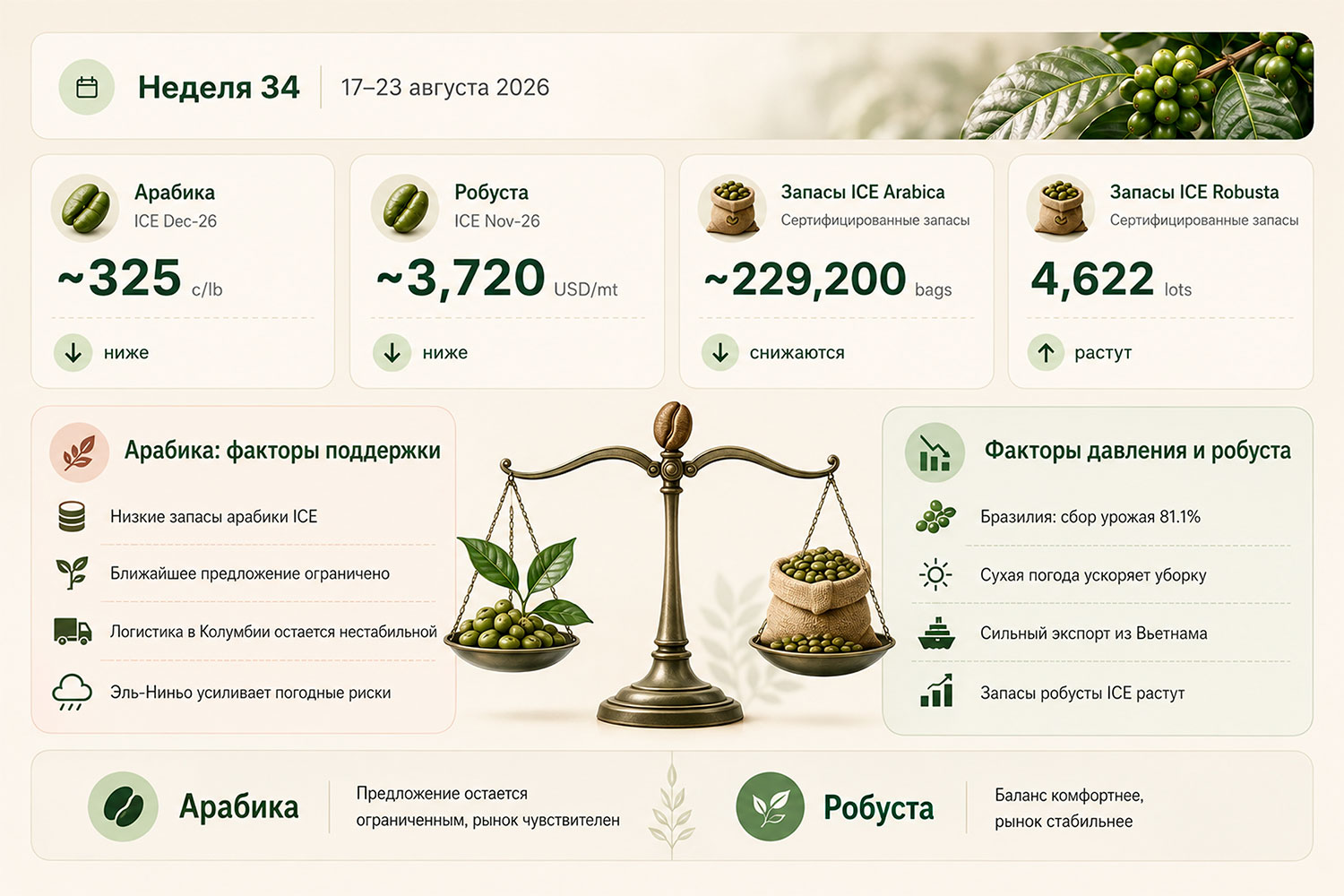
The December ICE arabica contract traded around 325 cents per pound, and the November robusta contract around $3,720 per tonne. Both markets ended the week lower.
Falling quotes do not mean arabica supply is back to normal, though. ICE certified stocks have dropped to around 229,000 bags — the lowest in roughly 2.75 years.
The spread between nearby and later arabica contracts also remains unusually wide. That shows coffee available for delivery now is considerably more expensive than future volumes.
This market structure makes arabica especially sensitive to even relatively small disruptions to supply, logistics or exports.
You can follow the wider trend in arabica and robusta prices in our green coffee market review for July 2026.
Brazil is speeding up the harvest
Brazil remains one of the main sources of pressure on the market. As of 14 August the coffee harvest in the regions Cooxupé works with had reached 81.1%, against 74.6% a week earlier.
The pace is still slightly behind last year, when 86.1% of the crop had been picked by this point, but the gap is closing fast. Dry weather is helping producers speed up field work: the state of Minas Gerais saw around 0.6 mm of rainfall over the week.
As the new crop arrives, the physical supply of coffee increases. If Brazilian producers start selling coffee more actively or hedging future shipments through futures, the pressure on arabica prices could intensify.
Brazilian arabica exports, meanwhile, remain comparatively restrained. In July they came to around 1.82 million bags, 8.9% less than a year earlier. Conilon exports, by contrast, remain high.
Current offers of green coffee from Brazil and other origins can be found in the Green Coffee Hub catalogue.
Supply risks in Colombia have eased
After the strong earthquake in western Colombia, the market feared serious disruption to coffee exports.
Part of the freight flow was rerouted through Caribbean ports, which avoided a complete halt to exports. According to the available data, the main problems right now have to do with damaged infrastructure and inland transport rather than large-scale damage to coffee farms and processing facilities.
The immediate risk of a serious shortage of Colombian arabica has therefore fallen. Delays in moving coffee within the country and shipping it onward are still possible, however.
Robusta looks steadier
The robusta market is in a more comfortable position.
Certified exchange stocks have grown to 4,622 lots, and Vietnam continues to ship high volumes. That improves robusta availability on the world market and limits the scope for another strong rally.
In Indonesia, Asalan coffee traded at around 68,000–69,000 Indonesian rupiah per kilogram. Trading activity stayed moderate, and sellers were in no hurry to cut export offers in line with falling futures.
As a result the contrast between the arabica and robusta markets is becoming clearer: nearby arabica supply remains short, while the robusta balance is gradually improving.
El Niño is becoming the main weather risk
The next important factor for the market is a strengthening El Niño.
According to CCR data, NOAA expects the event to strengthen further through the end of 2026. Its July forecast put the probability of a very strong El Niño between October and December at 81%.
For the coffee market that adds uncertainty around future crops. The development of El Niño does not automatically mean lower production, however.
Over the coming months what will matter most is the actual temperature and rainfall in the main coffee regions of Brazil, Vietnam and other producing countries.
What is driving the market now
In the short term arabica continues to draw support from minimal stocks and limited nearby supply. News about logistics, weather or exports can therefore still trigger sharp price moves.
At the same time the fundamentals are gradually shifting: the Brazilian harvest is accelerating, robusta supply is becoming more comfortable, and the new crop is making coffee easier to source on the physical market.
The market is thus caught between two opposing forces: an arabica deficit here and now, and the prospect of greater supply in the coming months. That contradiction is likely to keep prices volatile through the end of August.
For companies planning green coffee purchases and considering production of their own, we have also looked in detail at why now is a good time to start roasting coffee in Uzbekistan.
Based on market reviews by Central Coffee Roasting (CCR).