
How the Coffee Market in Uzbekistan Is Developing: From Instant Formats to Local Roasting

The coffee market in Uzbekistan is still in an active stage of formation. Historically, the country has remained a tea-driven market, but in recent years coffee has become increasingly visible in everyday consumption: the number of coffee shops is growing, the coffee-to-go culture is developing, and interest in whole-bean coffee and local roasting is rising.
According to open market estimates, total coffee demand in Uzbekistan may grow from 6 thousand tons in 2023 to 7.74 thousand tons by 2028. For a market where coffee has not yet become a basic daily habit for most of the population, this is an important signal: the category is moving beyond a narrow urban audience and is gradually becoming part of broader consumer behavior.
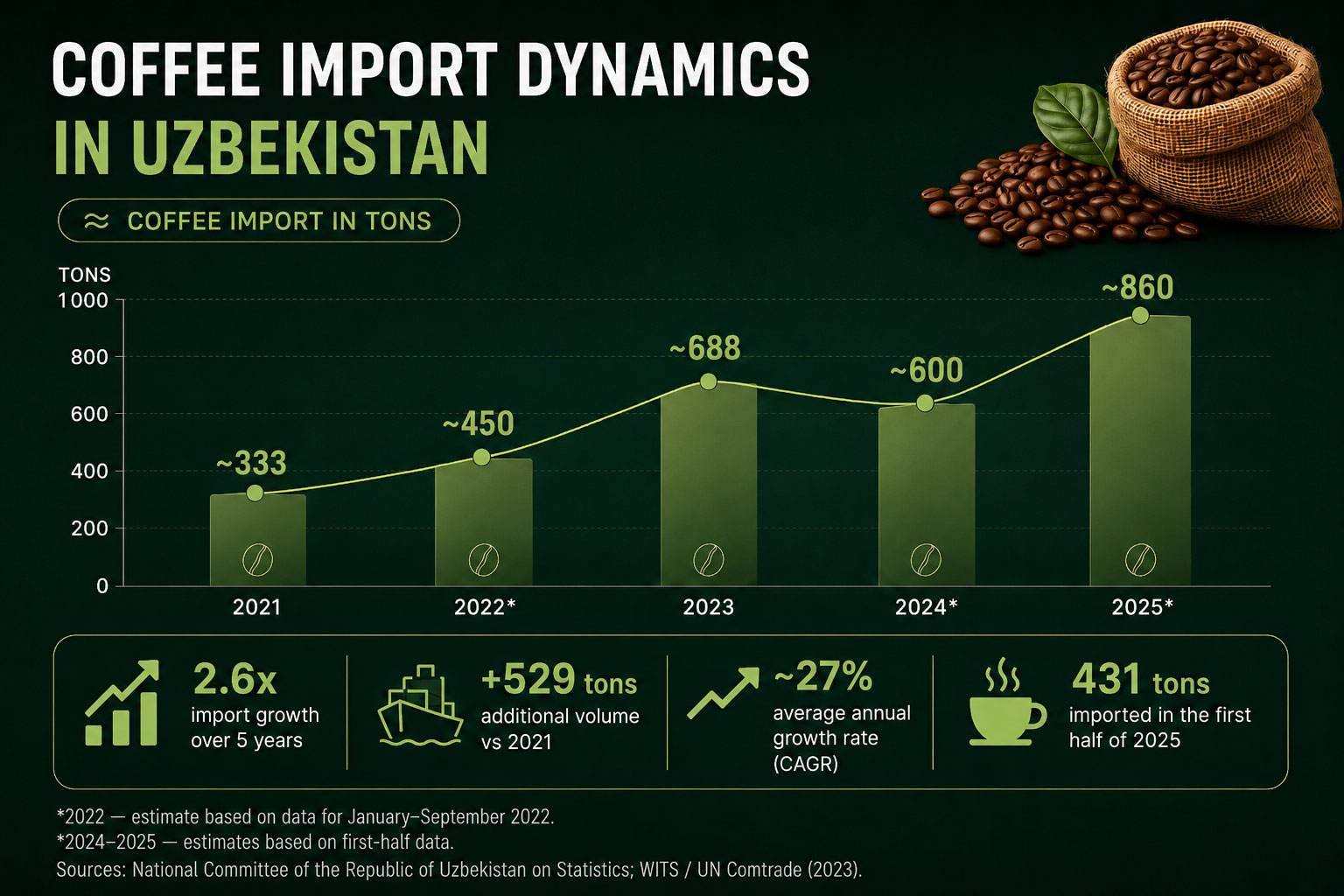
At the same time, the market remains heterogeneous. A significant share of consumption still comes from instant coffee, coffee mixes, and affordable mass-market formats. At the same time, interest is growing in fresh coffee, whole-bean coffee, coffee shops, and professional consumption. This is also confirmed by open trade statistics: in January–June 2025, Uzbekistan imported 431 tons of coffee, which is 133 tons more than in the same period of 2024.
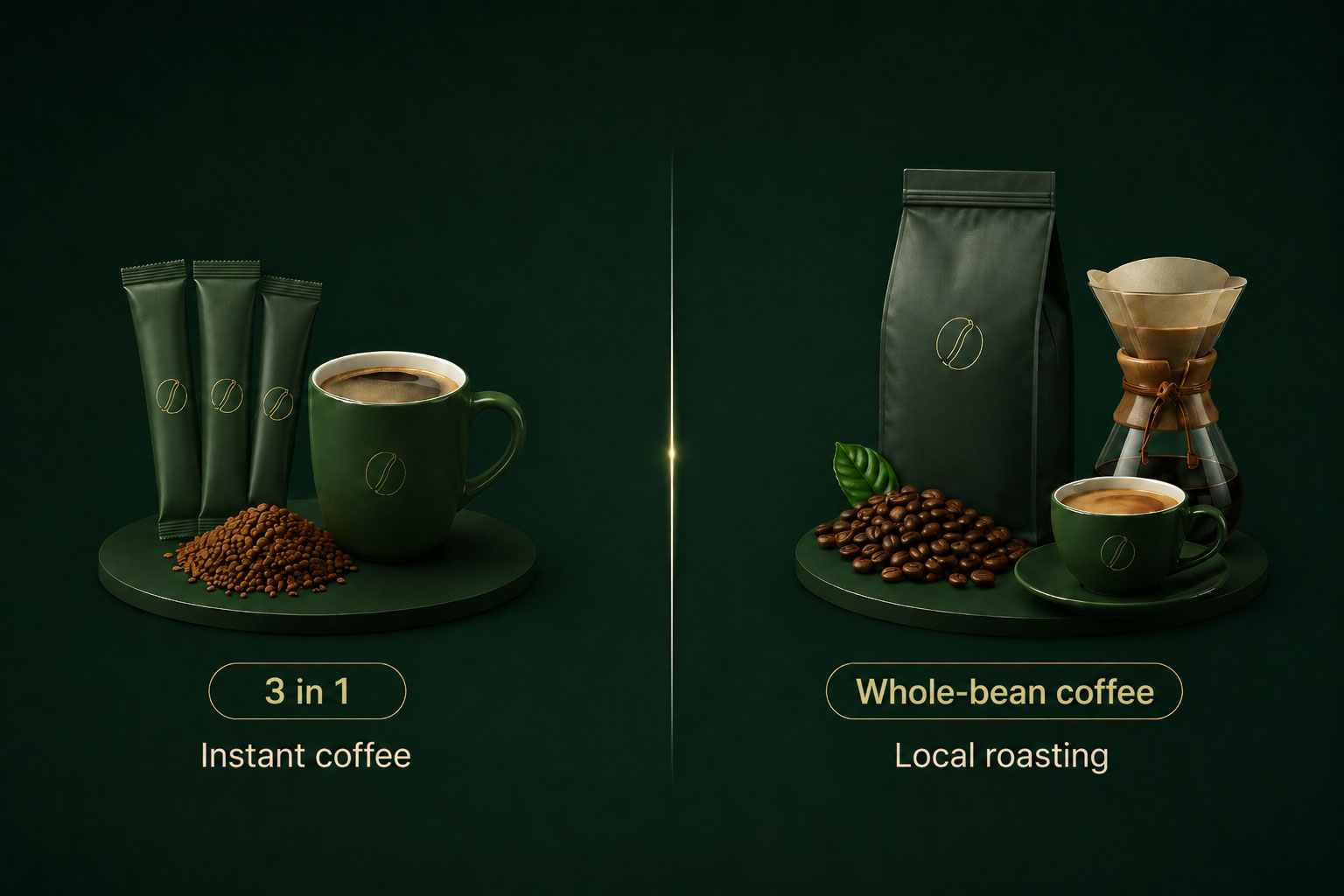
Against this backdrop, the gap between the mass instant coffee segment and the new urban demand for quality coffee becomes especially noticeable. It is precisely between these two poles that space is beginning to emerge for local roasting and accessible mid-market whole-bean coffee.
A Market Between Two Poles
Today, the coffee market in Uzbekistan can be conditionally divided into two major segments.
The first is the mass, affordable segment: instant coffee, 3-in-1 coffee drinks, and inexpensive formats for everyday consumption. It remains the most understandable option for a broad audience due to its price, familiar taste, and availability in retail.
The second is the urban premium segment: specialty coffee shops, signature drinks, local roasters, and venues with a higher average check. This segment is shaping a new coffee culture, but for now it is mainly concentrated in large cities, especially Tashkent.
This structure is also confirmed by market reviews: Euromonitor notes that demand for fresh coffee in Uzbekistan is growing rapidly, while instant coffee still remains the largest category by volume, and coffee mixes continue to play a significant role.
The Main Growth Point Is the Mid-Market Segment
Between instant coffee and expensive coffee shops, space is emerging for the most promising direction: affordable whole-bean coffee in the mid-market segment.
This includes coffee for vending machines, supermarkets, hypermarkets, construction stores, business centers, gas stations, and other high-traffic daily locations. For consumers, this is a “fast, convenient, and affordable” format — but no longer an instant drink, rather coffee made from beans.
This segment does not require rare microlots or expensive specialty positions. It needs stable commercial coffees: Brazil, Vietnam, and balanced Arabica-Robusta blends. These beans can provide a clear taste, good body, and a price point that remains closer to the mass market than to premium coffee shops.
This is the layer that can gradually change consumer habits. A person used to 3-in-1 coffee gets the opportunity to try a higher-quality bean-based product without a sharp price jump. After that, returning to instant formats becomes more difficult — not because of fashion, but because taste expectations begin to change.
Imports Show Growing Interest in the Category
Uzbekistan remains an import-dependent coffee market. According to the National Statistics Committee, in January–June 2025 the country imported 431 tons of coffee worth $3.9 million from 36 countries. This is 133 tons more than in the same period of 2024. The largest suppliers during this period were Italy, Brazil, Vietnam, Russia, Germany, and Lithuania.
These figures are important not only as an indicator of volume. The supplier structure shows that the market is developing in two directions at once: on the one hand, imports of ready-roasted products from countries with developed coffee industries remain significant; on the other hand, interest is growing in raw materials and commercial coffees that can be used for local roasting.
At the same time, the beginning of 2026 showed a decline in imports: in January–February, 136.2 tons of coffee were imported, which is 32.4% less than in the same period of 2025. This does not cancel the long-term growth trend, but it shows that the market is sensitive to prices, logistics, and fluctuations in demand.
Uzbekistan May Move Closer to Neighboring Markets
When comparing Uzbekistan with Kazakhstan, the gap in consumption volume no longer looks significant. According to ReportLinker estimates, coffee consumption in Kazakhstan was around 8 thousand tons in 2023 and may reach 8.2 thousand tons by 2028. For Uzbekistan, the 2028 forecast is 7.74 thousand tons. This means the market may come close to Kazakhstan in terms of volume, although Uzbekistan still has a development path ahead in terms of infrastructure, the number of local roasters, and the maturity of the coffee community.
Kazakhstan’s experience shows that the growth of the coffee category is connected not only with consumption, but also with the development of processing, retail, and local production. In 2025, production of processed tea and coffee in Kazakhstan reached 20.5 thousand tons, increasing by 18% compared to the previous year; at the same time, imports still accounted for more than 70% of market resources.
For Uzbekistan, this is an important benchmark: the market can develop not only through imports of finished products, but also through its own infrastructure — local roasting, B2B supply, training, cuppings, professional events, and work with green coffee.
What Will Drive the Market Further
In the coming years, growth in Uzbekistan’s coffee market will likely not come only from premium coffee shops. A more significant factor may be wider access to quality whole-bean coffee for a broader audience.
Key growth drivers include:
- stable green coffee supplies;
- development of local roasting;
- growth of vending and coffee-to-go formats;
- emergence of an affordable mid-market segment;
- expansion of HoReCa and modern retail;
- formation of a professional coffee community.
StrategyHelix also highlights urbanization, the growth of coffee culture, the development of freshly brewed coffee, retail modernization, and e-commerce as factors that will support the Uzbek market in the medium term.
The Role of Green Coffee Hub
Green Coffee Hub sees its role not only in supplying green coffee, but also in participating in the development of the region’s coffee infrastructure.
We work with green coffee as a professional B2B product: we inspect batches, receive samples, carry out test roasting and cupping, and evaluate the stability and flavor profile of lots. This helps roasters, coffee shops, HoReCa businesses, and distributors reduce risks and work with a clear, reliable product.
We consider the development of the mid-market segment especially important. Good coffee should not exist only in premium coffee shops. It can be available through vending, coffee to go, retail, and HoReCa — and it is through these formats that a wider audience begins to discover quality whole-bean coffee.
Uzbekistan’s coffee market is still forming, but its direction is already clear: demand is growing, interest in beans is increasing, and consumers are gradually becoming ready for a new stage of coffee culture.